



Hair transplant technology has come a long way in the last decade, and patients now have more options than ever before. Two techniques come up again and again, FUE (Follicular Unit Extraction) and DHI (Direct Hair Implantation). If you're looking into FUE or DHI hair transplant in Ahmedabad, it's worth understanding what actually separates the two before picking one based on a clinic's marketing page.
Both can deliver natural-looking results, but only in the right hands. The outcome depends heavily on your degree of hair loss, how good your donor area is, your hair's texture and thickness, and what you're actually trying to achieve.
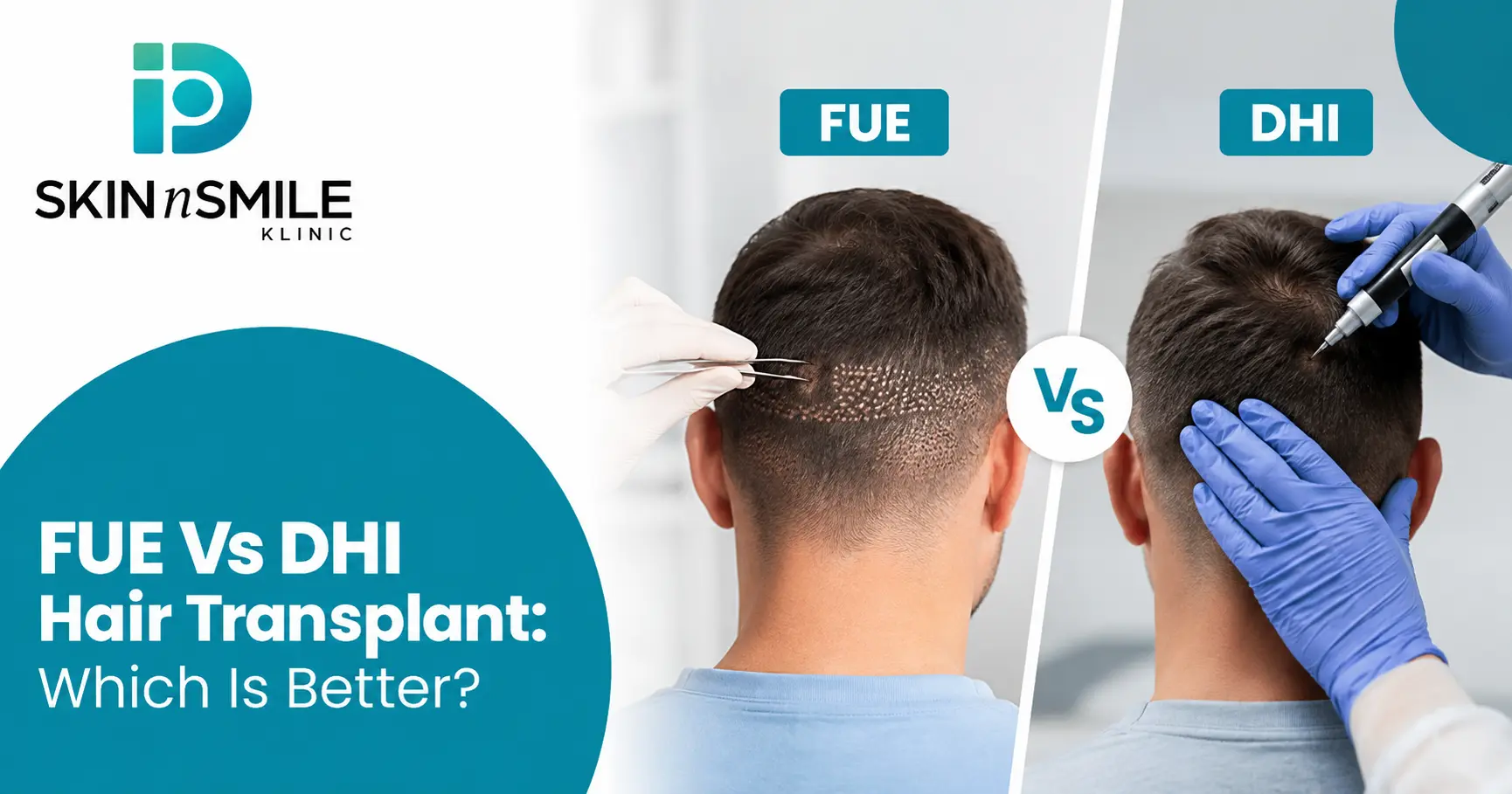
Which is Better, FUE or DHI?
Honestly, neither is automatically better for everyone.
FUE tends to get picked for larger bald areas since it's simply more efficient at covering ground. DHI, on the other hand, gives more control over exactly where and how each graft goes in, which matters a lot for hairline work or packing extra density into a small zone.
But here's the thing most people miss: the surgeon's skill usually matters more than which technique they use. A proper consultation is really the only way to figure out what's right for your scalp and your stage of hair loss.
What Is FUE Hair Transplant?
FUE is probably the most widely performed hair transplant technique out there.
During FUE:
- Individual hair follicles are extracted from the donor area.
- Tiny recipient sites are created in the balding area.
- The extracted grafts are implanted into these sites.
Since follicles come out one at a time rather than as a strip, FUE typically doesn't leave a long linear scar. Instead there are tiny extraction points that fade and become hard to spot over time.
Advantages of FUE
- Suitable for larger treatment areas
- No large linear scar
- Faster recovery compared to older strip methods
- Natural-looking results when performed correctly
- Suitable for many hair loss patterns
Limitations of FUE
- Requires careful graft handling
- Large sessions can take several hours
- Results depend heavily on surgeon experience
- Density may vary depending on graft availability
What Is DHI Hair Transplant?
DHI is a modified implantation approach, and most clinics do it using a specialized implantation pen, often called a Choi Implanter Pen.
In a DHI procedure:
- Hair follicles are extracted from the donor area.
- The follicles are loaded into a specialized implantation device.
- The grafts are implanted directly into the recipient area.
The real difference from FUE shows up at this last step: DHI lets the surgeon control angle, depth, and direction directly as each graft goes in, instead of placing grafts into channels prepared ahead of time.
Advantages of DHI
- Precise graft placement
- Better control of hair direction and angle
- Useful for detailed hairline work
- May help achieve higher density in selected cases
- Often preferred for smaller treatment areas
Limitations of DHI
- Usually takes longer
- Can be more expensive
- Not always necessary for extensive baldness
- Requires significant technical expertise
FUE vs DHI: Key Differences
| Feature | FUE | DHI |
|---|---|---|
| Extraction Method | Individual follicle extraction | Individual follicle extraction |
| Implantation Method | Grafts placed into prepared channels | Grafts implanted using implantation pen |
| Hairline Precision | High | Very High |
| Suitable for Large Bald Areas | Yes | Yes, but may require longer sessions |
| Procedure Duration | Moderate | Often longer |
| Cost | Generally lower | Usually higher |
| Recovery | Similar | Similar |
| Scarring | Minimal | Minimal |
| Density Control | Excellent | Excellent with proper planning |
One thing marketing materials tend to leave out: both procedures generally rely on the same follicular extraction method. What actually differs is how the grafts get implanted afterward.
Which Procedure Gives Better Density?
Both FUE and DHI can produce excellent density when the planning behind them is solid. Density itself comes down to several things:
- Number of available grafts
- Donor hair quality
- Hair thickness
- Hair colour and texture
- Scalp characteristics
- Surgical planning
- Surgeon expertise
Plenty of clinics market DHI as the higher-density option, but the implantation tool alone doesn't create density, proper graft distribution and long-term planning matter just as much.
Which Procedure Has Better Hairline Results?
DHI gets pushed a lot for detailed hairline design because of the precision its implantation pens offer. But a natural-looking hairline really comes down to things that have nothing to do with the tool itself:
- Correct angle placement
- Proper graft selection
- Facial proportions
- Hairline design expertise
- Long-term hair loss planning
A poorly designed DHI hairline can still look unnatural, while an expertly done FUE hairline can look completely natural. The tool doesn't rescue a bad plan.
Is DHI More Painful Than FUE?
Not really, no significant difference in pain is generally reported between the two.
Both procedures are usually performed under local anaesthesia. Patients may experience:
- Mild discomfort
- Tenderness
- Temporary swelling
- Tightness of the scalp
Pain perception varies quite a bit from person to person.
Recovery: FUE vs DHI
Recovery timelines are generally similar between the two.
| Stage | What to Expect |
|---|---|
| First Week | Mild redness, swelling, scabbing, tenderness |
| Weeks 2–4 | Healing progresses, transplanted hair may shed |
| Months 3–4 | Early growth begins |
| Months 6–9 | Noticeable improvement in density |
| Months 9–12+ | Continued maturation of results |
Sticking to post-operative instructions matters more for how recovery goes than which technique you actually chose.
Which Procedure Is Better for Advanced Baldness?
Patients dealing with extensive hair loss usually need a large number of grafts. For advanced baldness:
- FUE is commonly used since it can efficiently cover larger areas.
- DHI may still be an option depending on graft requirements and surgical planning.
The right approach ultimately comes down to donor capacity and treatment goals.
Final Takeaway
If you're researching DHI hair transplant in Ahmedabad, focus your attention on the surgeon's expertise, hairline design skills, donor area management, and long-term treatment planning, not just marketing claims. A personalised consultation at Skin n Smile Klinic is what actually determines whether FUE or DHI fits your hair restoration needs best. You can also call 91040 44040 to book your appointment