



Losing hair changes how you feel walking into a room, not just how you look in the mirror. FUE Hair Transplant Treatment in Ahmedabad at Skin n Smile Klinic gives people dealing with permanent hair loss or thinning a modern, less invasive path forward.
The technique itself, Follicular Unit Extraction, pulls healthy follicles one at a time from a donor site, then places them wherever hair's gone thin or vanished. Get the planning and skill right, and the growth that follows looks like it was always there.
What Is FUE Hair Transplant?
Think of it as precision work rather than a bulk procedure , follicles come out one by one from a donor area and go into thinning or bald spots, with no large strip of scalp removed in the process.
Most of the time those follicles are pulled from the back or sides of the scalp, since hair growing there tends to hold up better against genetic hair loss. From there, careful implantation follows your natural hairline, the direction your hair already grows, and the density that actually suits you.
Strip-based methods leave a linear scar; FUE trades that for small dot-like marks that fade well once healed. That's a big part of why people gravitate toward it when they want permanent restoration without the more invasive route.
Who Can Benefit from FUE Hair Transplant Treatment?
FUE tends to suit men and women dealing with pattern baldness, a receding hairline, general thinning, or specific patches of permanent hair loss.
At Skin n Smile Klinic, a detailed consultation is what determines whether FUE makes sense, or whether medical hair loss treatments should be tried first instead.
FUE treatment may be worth considering for:
- Male pattern baldness
- Female pattern hair thinning
- Receding hairline
- Crown baldness
- Hairline restoration
- Bald patches caused by certain conditions or injuries
- Beard or eyebrow restoration in suitable cases
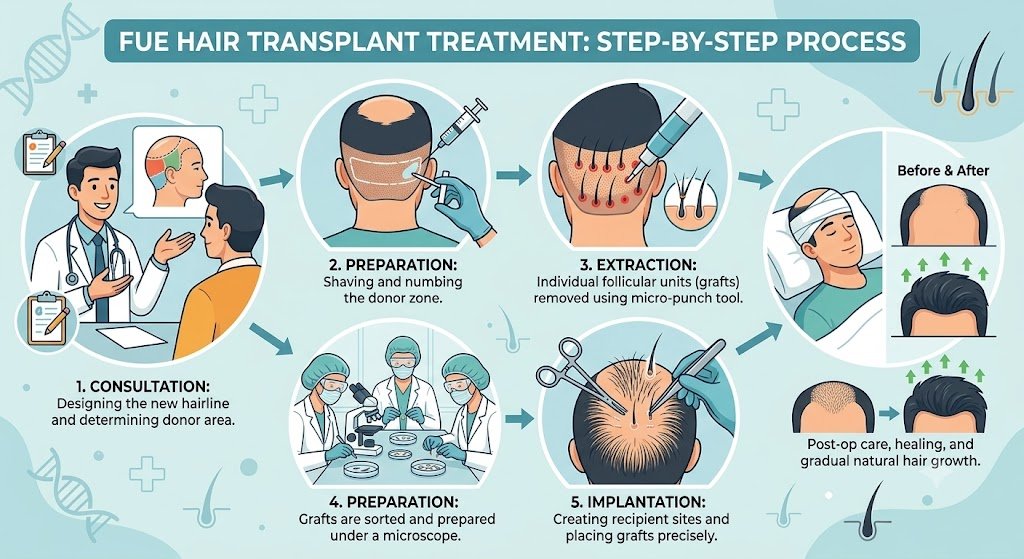
How Does FUE Hair Transplant Work?
FUE moves healthy follicles one at a time from the donor area into the areas hair loss has affected.
Every step gets planned carefully so the transplanted hair grows at the same angle and in the same direction as what's already there.
- 1 Step 1: Hair and Scalp Assessment Everything starts with figuring out why the hair loss is happening and what pattern it's following. The scalp and donor area get examined so the doctor knows roughly how many usable grafts are available.
- 2 Step 2: Hairline Planning Next comes designing a hairline that actually looks like it belongs on your face , factoring in your proportions, age, current hair density, and where things might head in the future.
- 3 Step 3: Donor Area Preparation The donor area gets prepped, and local anaesthesia goes in so the rest of the procedure stays comfortable.
- 4 Step 4: Follicle Extraction One by one, individual follicular units come out using specialised tools built for exactly this.
- 5 Step 5: Recipient Area Preparation Getting the angle right matters here, each tiny site across the thinning or bald patch has to line up with the way hair would've grown there on its own.
- 6 Step 6: Graft Implantation Finally, the extracted follicles go into those recipient sites, placed to build a distribution and density that looks genuinely natural.
Who Is the Right Candidate for FUE Hair Transplant Treatment in Ahmedabad?
Generally, someone whose hair loss has stabilised or is at least manageable, and who has enough healthy donor hair to work with.
A proper evaluation matters before anyone gets recommended for a transplant. Hair loss can stem from genetics, hormonal shifts, nutritional gaps, stress, underlying medical conditions, or scalp issues , and a transplant isn't necessarily the first thing worth trying.
During consultation, a few things typically get assessed:
- Type and cause of hair loss
- Age and future hair loss pattern
- Donor area density
- Hair texture and quality
- Scalp health
- Existing medical conditions
- Patient expectations
Talking to an experienced Hair Transplant Treatment Doctor in Ahmedabad helps make sure the plan actually fits you, instead of following some generic template.
FUE Hair Transplant vs Other Hair Loss Treatments
FUE is a surgical procedure; things like PRP, GFC, medicines, and topical solutions generally work by supporting the hair you still have rather than adding new follicles.
Which route actually makes sense depends on the stage and cause of your hair loss.
| Treatment | Best For | Main Purpose |
|---|---|---|
| FUE Hair Transplant | Permanent bald areas | Redistributing healthy hair follicles |
| PRP Treatment | Early hair thinning | Supporting existing hair |
| GFC Treatment | Hair thinning | Supporting hair growth |
| Medical Treatment | Certain types of hair loss | Managing the cause of hair loss |
| Topical Treatments | Early-stage thinning | Supporting existing hair |
Sometimes a combination ends up making the most sense. A consultation with a qualified Dermatologist in Ahmedabad can help pin down the plan that actually fits your case.
Why Choose Skin n Smile Klinic for FUE Hair Transplant in Ahmedabad?
Skin n Smile Klinic builds its hair restoration planning around your specific hair loss pattern, scalp condition, donor availability, and what you're actually hoping to achieve.
Hair transplantation isn't just about filling in bald spots. Real planning goes into building a hairline that looks natural while accounting for future hair loss and protecting the donor area for later.
At Skin n Smile Klinic, individual assessment comes before any procedure gets recommended.
If you're considering Hair Transplant in Ahmedabad, look for a proper consultation, honest expectations, transparent planning, and recommendations that actually fit your medical situation.
Aftercare Following FUE Hair Transplant
Good aftercare protects the newly placed grafts and helps healing go smoothly in those first weeks.
Following your doctor's instructions closely after the procedure really does make a difference.
Common aftercare guidance includes:
- Avoid touching or scratching the transplanted area
- Follow the recommended hair washing instructions
- Avoid strenuous exercise for the advised period
- Protect the scalp from direct trauma
- Avoid smoking if advised by the doctor
- Take prescribed medicines as directed
- Attend follow-up appointments
Exactly what applies to you can vary depending on your specific procedure and how healing's progressing.
Book a Consultation for FUE Hair Transplant Treatment in Ahmedabad
At Skin n Smile Klinic, treatment planning starts by figuring out the cause and stage of your hair loss before anything gets recommended. Your donor area, hair density, scalp health, and what's actually realistic all get covered in a detailed consultation.
Looking for a reliable Hair Transplant Treatment Doctor in Ahmedabad? Book a consultation to go over your options and walk away with a plan built around you.