



Wondering what the best age for a hair transplant actually is? Truth is, there's no single age that's right for everyone. A transplant usually makes sense once hair loss has become sufficiently stable, the donor area has enough healthy hair to work with, and the expected result can actually be planned for the long haul. If you're exploring Hair Loss Treatment in Ahmedabad, Skin n Smile Klinic can assess your hair-loss pattern, scalp condition, donor area, and future hair-loss risk before saying whether a transplant makes sense.
Age matters, sure, but it's only one piece of the puzzle. Your diagnosis, how advanced the baldness is, family history, how much donor hair you have, and what you're actually expecting all carry equal weight.
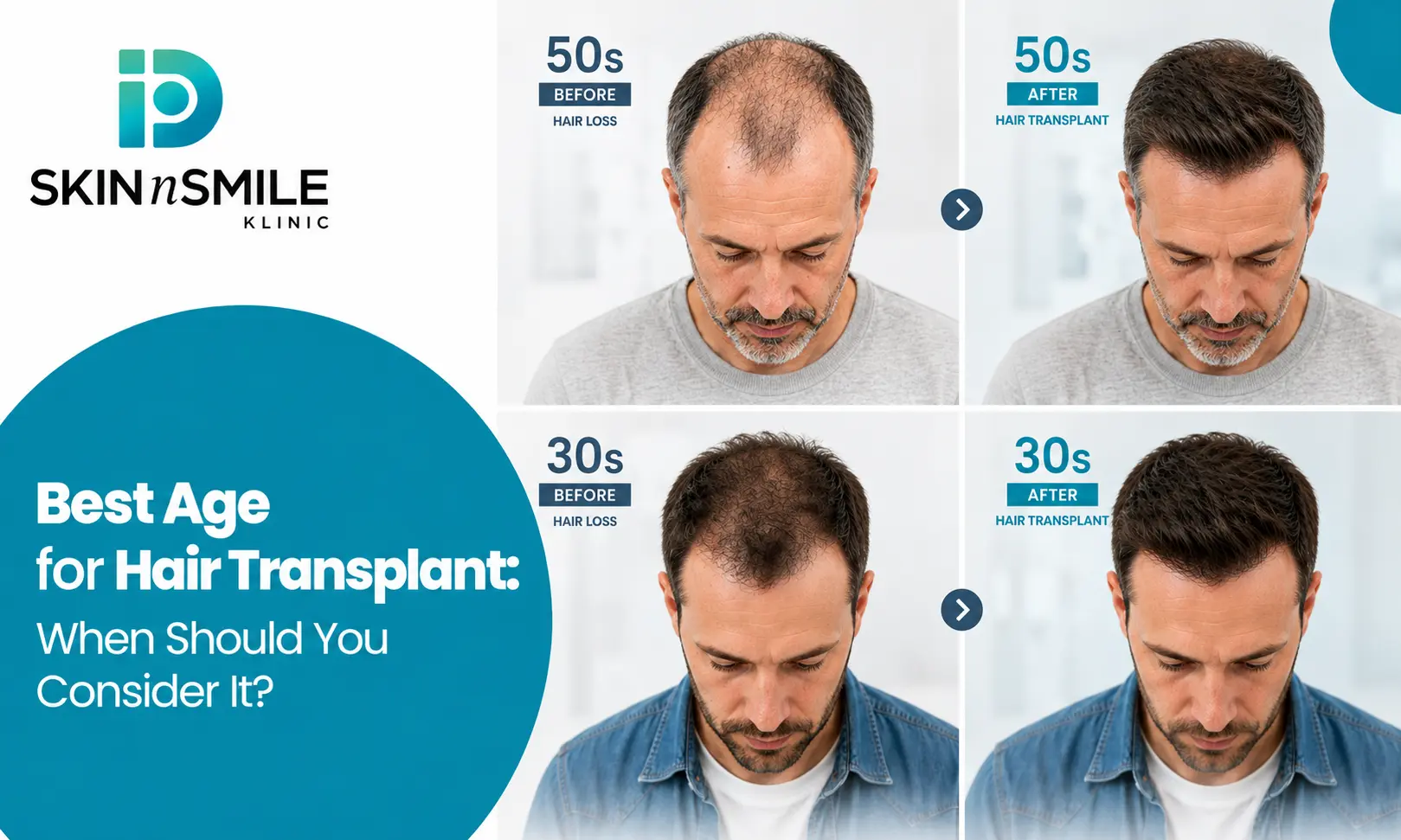
What Is the Best Age for a Hair Transplant?
For many patients, the late 20s to 30s tend to work out better, but there's no strict minimum or maximum age.
A transplant might make sense earlier or later depending on how stable the hair loss is and whether there's enough donor hair to go around.
The real question isn't:
"How old are you?"
"Is your hair loss stable enough to plan something that'll actually hold up long-term?"
A younger patient whose hair loss is progressing fast may not be the best candidate right now, while an older patient with stable baldness and a healthy donor area could be an excellent one.
Can You Get a Hair Transplant Before 25?
Yes, but being under 25 doesn't automatically mean you should, or shouldn't, get one done.
Hair loss can start in the late teens or early twenties, especially for men with a strong family history of androgenetic alopecia. The catch is that at this age, it may still be actively progressing.
Doing a transplant while baldness is moving fast can create headaches down the road.
For younger patients, a specialist will often recommend first:
- Monitoring how the hair loss is progressing
- Medical treatment where it fits
- Assessing the Norwood stage
- Evaluating the donor hair
- Understanding family history
- Setting realistic expectations
If the hair loss turns out to be stable and the patient checks the right boxes, transplantation can sometimes still be considered.
Hair Transplant in Your 20s
A transplant in your 20s can work in select cases, but careful assessment matters even more here.
Potential advantages
- Addressing established hair loss
- Improving confidence
- Restoring selected areas of permanent hair loss
- Creating a carefully planned hairline
Important considerations
- Hair loss may still be progressing
- Future donor hair needs have to be factored in
- Medical treatment might be recommended first
- The hairline should be designed conservatively
- Expectations need to stay realistic
A good surgeon thinks about how that hairline will look not just at 25, but at 35, 45, and beyond.
Hair Transplant in Your 30s
The 30s tend to be a practical window for transplantation, since by this point many patients have a clearer, more settled hair-loss pattern.
That said, age alone still doesn't make someone a candidate. Someone in their 30s could still have rapidly progressing hair loss, while someone else the same age might have stable baldness and a strong donor area.
Same questions apply either way:
- Is the diagnosis clear?
- Is hair loss sufficiently stable?
- Is the donor area healthy?
- Is there enough donor hair?
- Are expectations realistic?
- Has future hair loss been factored in?
Hair Transplant in Your 40s
Transplants can absolutely be done successfully in the 40s too.
At this stage, the hair-loss pattern is often more settled, which can make long-term planning a bit easier. But the quality and density of the donor area becomes especially important here — a specialist needs to check whether the available donor hair can give proper coverage without over-harvesting.
Hair Transplant After 50
There's no universal upper age limit on this. Patients over 50 can still be great candidates if they're in good general health, have enough donor hair, and hold realistic expectations.
At this age, doctors tend to pay closer attention to:
- General health
- Medication history
- Scalp condition
- Donor hair density
- Hair calibre
- Healing ability
- The patient's goals
A medical evaluation is non-negotiable before any surgical procedure.
Does Age Affect Hair Transplant Results?
Age can shape treatment planning, but it doesn't by itself determine how good the final result looks.
What actually matters more:
- Donor hair quality
- Number of available grafts
- Hair-loss pattern
- Scalp condition
- Hair characteristics
- Surgical technique
- Hairline design
- Graft handling
- Post-operative care
- Future hair-loss progression
A well-planned transplant accounts for both where things stand now and where they might go later.
Hair Transplant vs Hair Loss Treatment
A transplant and medical hair-loss treatments really do different jobs.
| Hair Loss Treatment | Hair Transplant |
|---|---|
| May help preserve existing hair | Restores hair to areas of permanent loss |
| Usually requires ongoing treatment | Surgical procedure |
| May slow progression | Does not stop future loss in untreated follicles |
| Useful in early stages | Often considered when permanent loss is established |
| Results vary by treatment | Results depend heavily on donor hair and planning |
Some patients end up benefiting from a mix of both.
Final Takeaway
The best age for a hair transplant isn't tied to a birthday. The right time is when your hair loss has actually been diagnosed properly, has stabilised enough, your donor area can support the procedure, and there's a long-term restoration plan in place.
If you're considering Hair Loss Treatment in Ahmedabad, Skin n Smile Klinic can help you figure out whether you're ready for a transplant or whether another treatment should come first. You can also call 91040 44040 to book your appointment. A carefully planned procedure should aim to do more than just improve how things look right now, it should also protect your donor hair and keep results looking natural as you age.